Football-field lighting in Malaysia: when DIALux needs vertical illuminance
Learn when a Malaysian football-field DIALux study should add vertical or camera-facing illuminance to the usual horizontal pitch calculation.
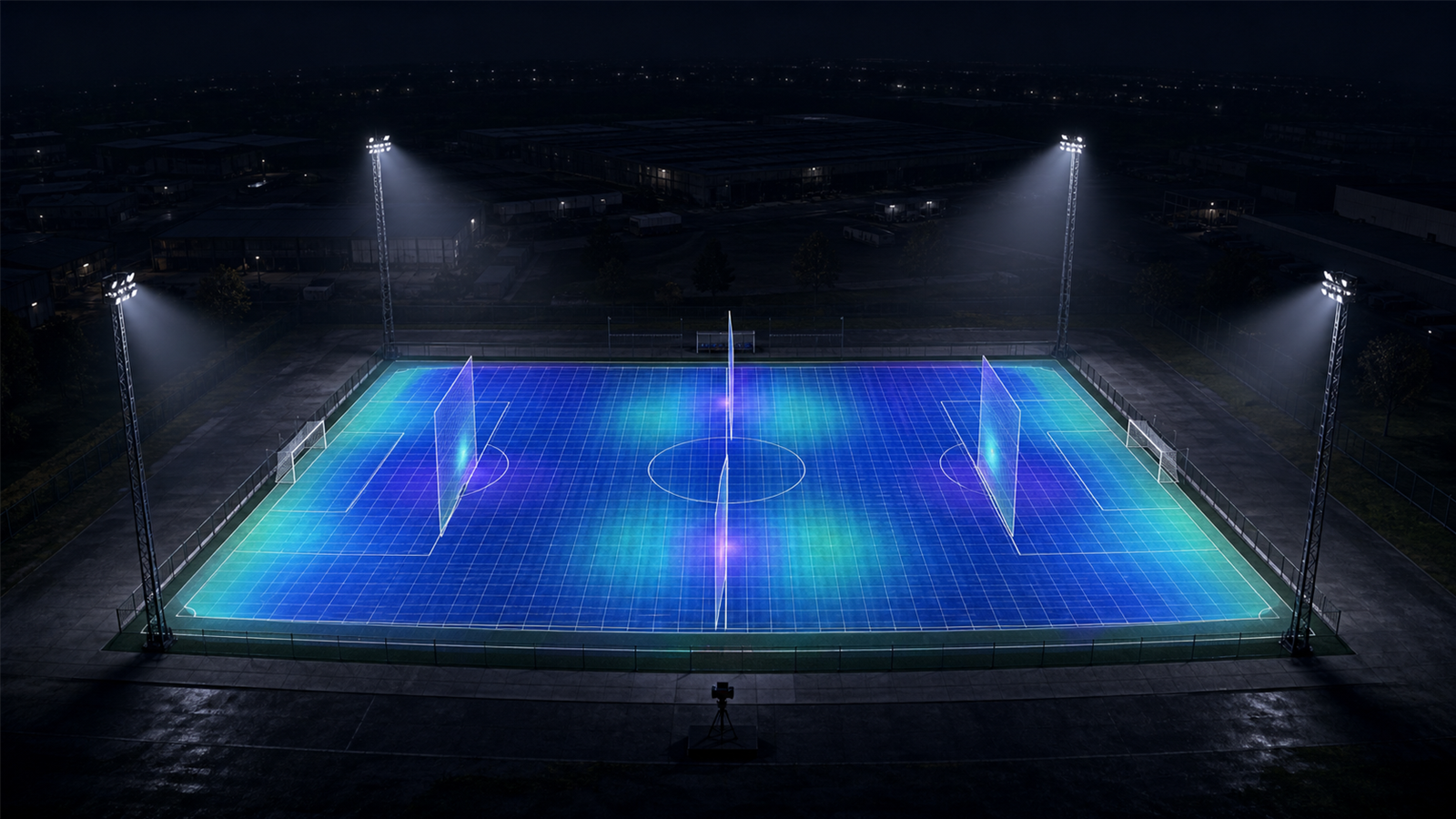
Horizontal and vertical illuminance answer different questions
Horizontal illuminance describes the light arriving on the playing surface. It is central to checking pitch coverage, minimum points and uniformity for players, officials and spectators. Vertical illuminance describes light arriving on an upright plane, so the result changes with the direction that plane faces.
For a football-field calculation, one bright horizontal result cannot automatically describe how a player, ball or scene appears from a camera direction. The two measurements should not be mixed or compared as though they are the same result.
Decide the field's real use before creating the calculation grid
A community training pitch, school field and broadcast venue do not automatically need the same evaluation package. FIFA's stadium guidance explains that horizontal illuminance supports players and spectators, while specific vertical-illuminance requirements mainly enter when television broadcast is part of the venue brief.
That distinction prevents unnecessary modelling and misleading claims. If broadcast is not planned, the project may concentrate on the agreed horizontal illuminance, uniformity, glare and spill criteria. If cameras are part of the brief, their likely positions and directions must be confirmed before vertical calculation planes are added.
Camera-facing planes need a stated direction
Vertical illuminance is directional. A point can receive a useful result on a plane facing one touchline and a weaker result on a plane facing the opposite side. For broadcast work, the model may need several vertical orientations across the pitch or a calculation directed towards the principal camera positions.
The official DIALux FAQ states that current DIALux evo can create most calculation surfaces needed for sports lighting and can calculate camera-oriented illuminance. The report should still show the grid height, plane orientation, camera reference and result type so another reviewer can understand exactly what was tested.
Aiming changes vertical light, glare and spill together
Tilting a floodlight towards a camera-facing plane can improve vertical illuminance, but it can also increase glare for players or send more light beyond the field. Pole position, mounting height, beam distribution and aiming therefore have to be reviewed as one arrangement rather than optimised one value at a time.
Compare alternatives using the exact IES or LDT file for the proposed floodlight. Keep the calculation surfaces, maintenance assumptions and display scales consistent, then review horizontal results, vertical results, glare-related checks and surrounding spill together before selecting the layout.
What a useful Malaysian football-field report should record
Provide the pitch dimensions, intended level of use, pole locations, mounting heights, floodlight photometry, aiming constraints, camera positions where relevant, operating scenes and the performance criteria adopted by the project team. Separate training, match and broadcast scenes if they use different luminaires or output levels.
FIFA tournament guidance can be a useful technical reference, but it is not automatically the governing requirement for every Malaysian field. The applicable client brief, league or association rules, local authority conditions and current project specification must be confirmed. A DIALux calculation supports the design and submission record; final acceptance remains with the responsible consultant, client and relevant authority.
Frequently asked questions
Does every football field need a vertical-illuminance calculation?
No. The required metrics depend on the field's intended use and governing brief. Camera-facing vertical illuminance is especially relevant where television or professional video coverage is required, while a non-broadcast pitch may focus on horizontal illuminance, uniformity, glare and spill.
Can DIALux calculate illuminance towards a camera?
Yes. DIALux states that current DIALux evo can calculate camera-oriented illuminance. The camera directions, calculation planes, exact floodlight photometry and adopted project criteria still need to be defined and documented correctly.