What files and dimensions are needed for a DIALux football-field lighting calculation?
Prepare a DIALux football-field lighting calculation with the right field plan, mast geometry, photometric files, criteria and surrounding-site inputs.
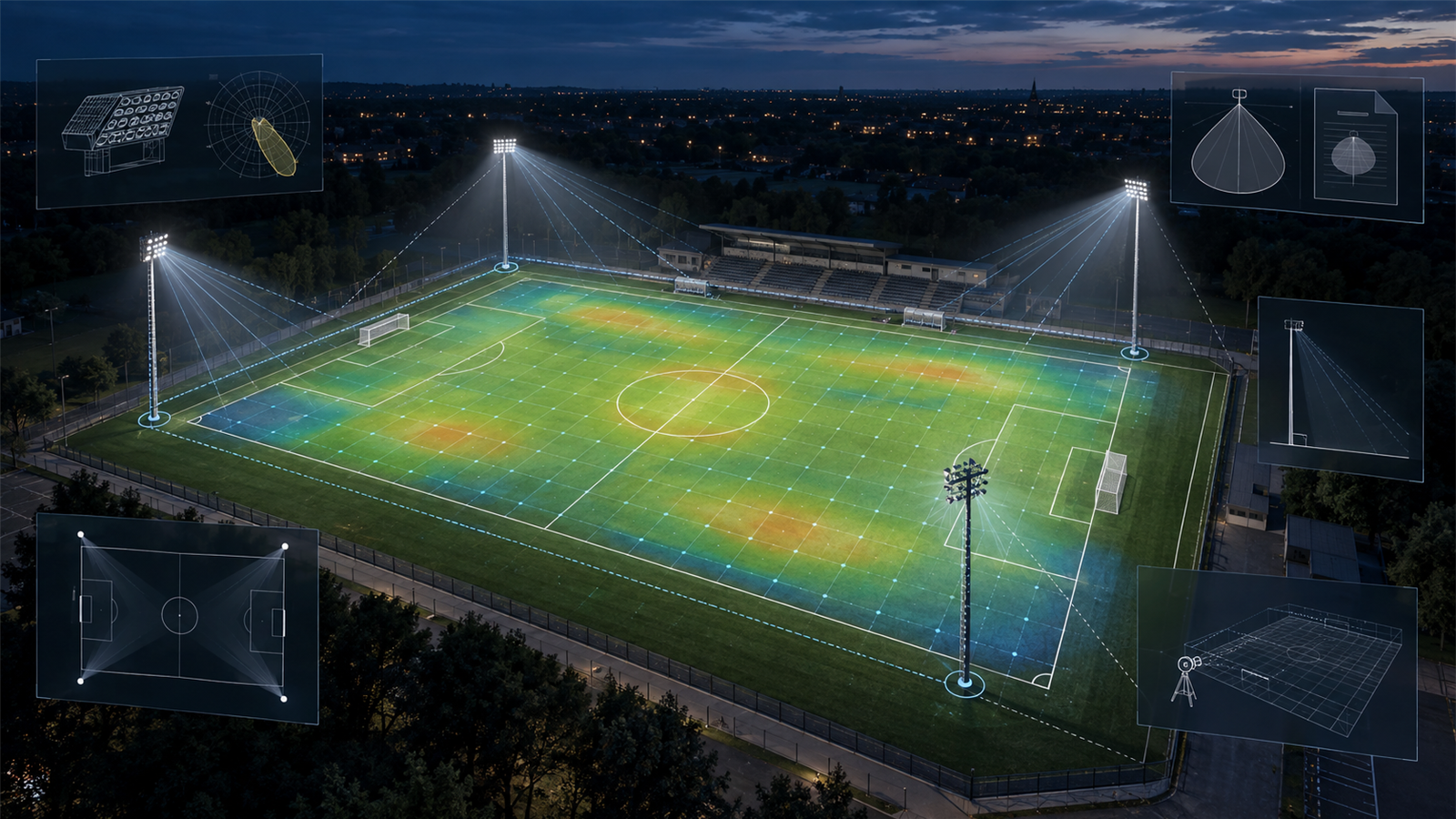
The short answer: supply the field, masts, luminaires, criteria and surrounding constraints
A reliable DIALux football-field lighting calculation needs a scaled pitch plan, exact playing-area and marking dimensions, mast or mounting coordinates and heights, the proposed floodlight models with their IES or LDT photometric files, the required playing and viewing criteria, and enough surrounding-site information to assess glare and spill. A photograph and a target lux value are not a complete brief.
State whether the project is for training, community play, competition, broadcast, refurbishment or option comparison. That use determines which horizontal and vertical surfaces, observer or camera directions, uniformity, glare, colour, flicker and operating-scene information the design team may need. The client, consultant or authority must confirm the applicable current criteria.
1. Begin with a scaled site and field plan
Provide an accurate DWG or another scaled drawing where possible. A dimensioned PDF or image can support modelling when it has a trustworthy scale and reference points. Mark the field-of-play boundary, touchlines, goal lines, centre line, penalty areas, goals, run-off zones and any adjacent training or circulation areas that form part of the brief.
Include north, coordinates or a clear local origin so mast positions and aiming schedules can be documented consistently. If the actual field differs from a standard template, use the surveyed dimensions. A calculation surface drawn to a guessed pitch size can produce a neat report for the wrong area.
2. Record every possible mounting position
For each existing or proposed mast, provide plan coordinates, mounting height, bracket or headframe dimensions, orientation, floodlight quantity and any structural limit on tilt or outreach. Where luminaires mount on a roof, grandstand or low side structure, include the relevant elevations and sections rather than representing every fitting at one convenient height.
Setbacks from the field, goals, spectator areas and site boundaries affect beam length, aiming angle and glare. Also record obstructions such as roofs, trees, scoreboards, fencing and nearby buildings when they block light or create sensitive viewpoints. The lighting model cannot infer these constraints from the pitch markings alone.
3. Use the exact floodlight photometry and operating data
Supply the exact manufacturer, model, optic, output setting and IES or LDT file for each proposed floodlight. Confirm whether the photometric file represents the intended mounting orientation and whether the luminaire has internal tilt, shields, visors or multiple light-emitting surfaces. A generic beam-angle description is not a substitute for measured distribution data.
Add rated power, driver or dimming information, colour temperature, colour-rendering data and flicker information when the project criteria require them. If several optics or outputs are under consideration, label each file clearly and keep the comparison controlled so changes in layout are not confused with changes in photometry.
4. Define what the calculation must prove
List the governing standard, sports-body guidance, client brief and competition or venue category instead of providing an isolated average-lux target. Confirm the required horizontal illuminance, minimum and uniformity measures, and whether vertical illuminance is needed for players, spectators, officials or cameras. Identify the calculation grid, reference height and any exclusion or run-off zones.
FIFA's stadium guidance explains that floodlighting design can be driven by player and spectator needs as well as television production. It highlights installation geometry, mast position, equipment, aiming, beam control, horizontal and vertical illumination, uniformity, glare, colour, flicker and unwanted spill. The applicable requirements still depend on the venue and intended use.
5. Map cameras, spectators and glare-sensitive viewpoints
When broadcast or recording is relevant, provide the anticipated main-camera, reverse-camera and other agreed camera positions and viewing directions. Vertical illuminance is directional: a result toward one side of the pitch does not describe every camera view. For non-broadcast fields, player, goalkeeper, official and spectator sightlines may still require deliberate glare review.
Identify stands, benches, paths, neighbouring windows, roads and property boundaries where direct intensity or spill matters. The correct observer points and limits come from the agreed criteria. Adding them after the floodlights have been aimed can force a larger redesign than including them in the starting model.
6. State maintenance and operating scenes
Confirm the maintenance factor or the information needed to derive it, including environment, cleaning interval, luminaire maintenance and the project team's maintenance plan. Make clear whether the result is maintained or initial. Do not compare a maintained option with an initial-light output and call the difference a luminaire improvement.
List the required operating scenes: full competition, training, maintenance, partial-field use, broadcast or other agreed modes. For each scene, identify which floodlights operate and at what output. DIALux can document lighting scenes, but the brief must define the real switching and dimming logic.
7. Include the surrounding environment and deliverables
Provide the site boundary, nearby residential or transport receptors, environmental-zone basis and any project-specific light-immission requirement. DIAL's official outdoor-lighting guidance describes calculation tools for glare-related quantities, upward light and direct light at window areas. These checks require the relevant geometry and assessment points.
Agree the deliverables before modelling: DIALux project file, luminaire and aiming schedule, layout plan, calculation grids, isolines, false-colour views, glare or spill results, assumptions and option comparison. State whether a CAD export, installation coordinates or a particular report format is required so the final model can support implementation as well as review.
Football-field input checklist
Before calculation, collect: (1) scaled DWG or dimensioned plan; (2) field and run-off dimensions; (3) mast coordinates, heights and headframes; (4) exact floodlight IES or LDT files; (5) mounting, shielding and output limits; (6) venue use and governing criteria; (7) horizontal and vertical calculation surfaces; (8) camera, player, spectator and boundary viewpoints; (9) maintenance assumptions; and (10) operating scenes and required outputs.
Before issuing, verify that the model scale and mast coordinates match the source information, every photometric file is traceable to the proposed optic, aiming and scene states are documented, maintained results are labelled, and limitations or missing inputs are visible. A DIALux calculation can support design evaluation or submission; acceptance remains with the relevant client, consultant or authority.
Authoritative references used for this guide
DIAL's official Outdoor Lighting with DIALux evo page covers scaled DWG or image-based construction, luminaire selection and positioning, mounting height and beam-angle adjustment, calculation surfaces, results, lighting scenes, light-immission checks and documentation. Its current product material also distinguishes supported features from future sports and floodlighting tools.
FIFA's Football Stadiums Guidelines section on technical systems and services describes the relationship between stadium lighting, field geometry, mast or roof positions, aiming, horizontal and vertical illumination, uniformity, glare, colour, flicker, broadcast viewpoints and unwanted spill. Project-specific criteria should be confirmed from the current governing documents rather than copied from an unrelated venue.
Frequently asked questions
Can a football-field DIALux calculation start from a satellite image?
A scaled image can help establish context, but it should not replace verified field, mast and boundary dimensions when the result will guide equipment or installation. Use surveyed or dimensioned project information wherever the decision is sensitive to position or height.
Is an IES or LDT file enough to compare football floodlights?
No. Photometry is essential, but the comparison also needs the correct optic and output, mast geometry, aiming limits, calculation criteria, maintenance basis, glare and spill viewpoints, and consistent operating scenes.